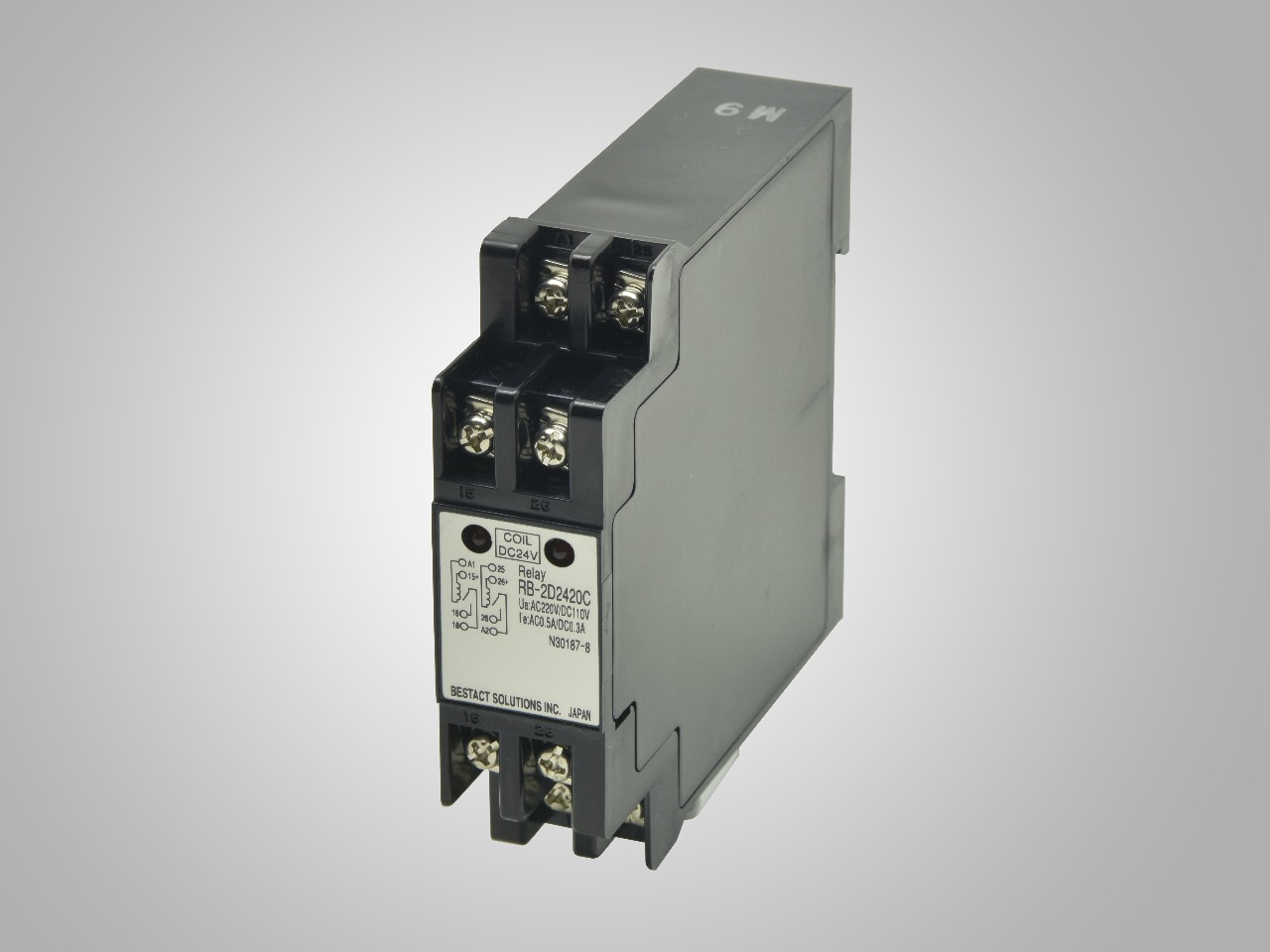
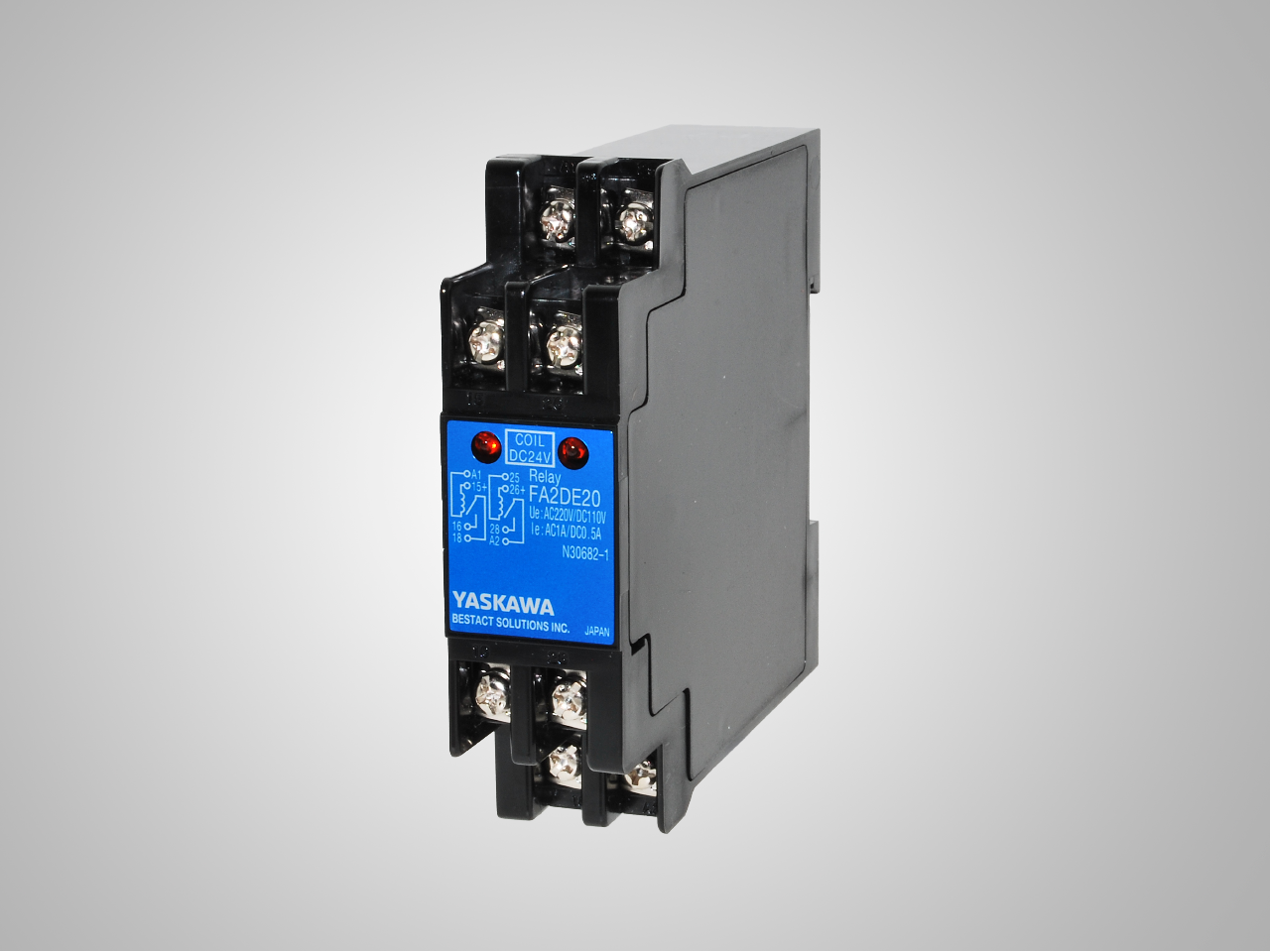
Product List

The "medium capacity type" and "large capacity type" representing the contact capacity indicate that Bestact R25 and R15 are to be incorporated.

What is a Relay?

A relay is an electrical switching device that opens or closes a circuit in response to an electrical signal.
Relays are used in a wide range of equipment and machines that are controlled by electrical signals, from familiar products such as home appliances to industrial products and control panels.
There is also a wide variety of relays, and relays suitable for various applications are used in a wide range of situations.

Definition of Electromagnetic Relay

In general, an electromagnetic relay is a device that switches electrical circuits on and off by energizing or de-energizing a coil, causing its contacts to open and close through electromagnetic force. They are also referred to as electromagnetic relays or mechanical relays.
Among them, small electromagnetic relays for control are defined as "hinged and reed type electromagnetic relays for use in electric circuits with an AC or DC frequency of 50 Hz or 60 Hz, a voltage of 250 V or less, and a current of 30 A or less". (See JIS C 5442 (corresponding international standard: IEC 255-7))
The electromagnetic relays we handle are reed type electromagnetic relays that employ the Power Reed Switch (Bestact), which has our original structure.

Reed and Hinged Relays

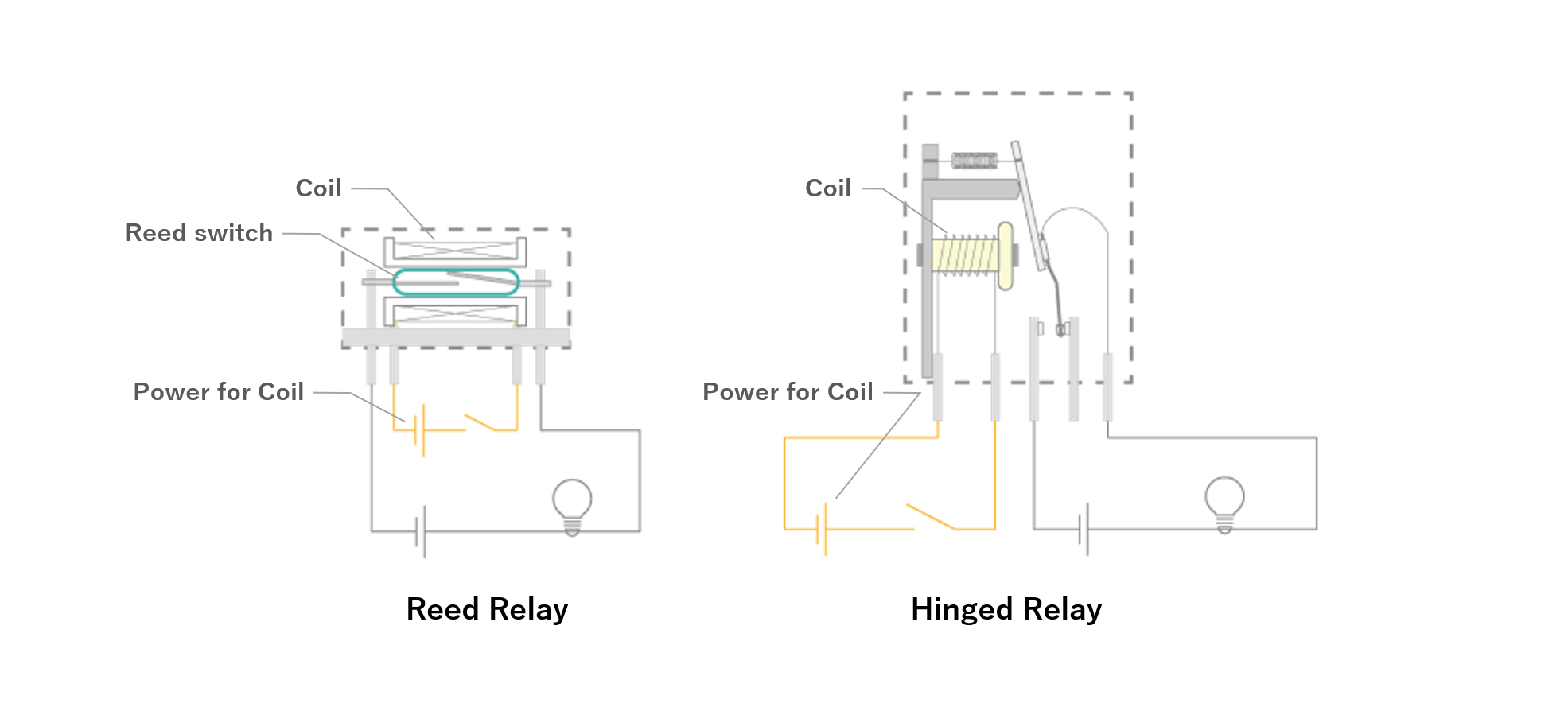
Both "reed relays" and "hinged relays" use the electromagnetic force of the coil to drive the contacts, but the principle and structure are different. A reed relay uses a reed switch as its contact mechanism, and the contacts are opened and closed by the magnetic field generated by the coil. A hinged relay uses a hinge mechanism, and the magnetic force of the coil causes the contacts to rotate about the hinge, opening and closing the circuit.
Features of Reed Relays
 The main features of reed relays are as follows:
 ➀ The contact part is sealed in a glass tube, making the contact mechanism less susceptible to external influences such as dust and organic gas (silicone gas).
 ② An inert gas is sealed inside the glass tube to prevent oxidation of the contacts.
 As a result of the above, the reed type relay has excellent durability and reliability.

Types of Reed Relays

Reed relays are broadly classified into PCB mounting relays and plug-in relays.

PCB-Mount Relays
PCB-mount relays are designed for direct mounting on printed circuit boards (PCBs). They are characterized by their small size, relatively low power consumption, and high operating speed.

How to Select a Relay

Key factors in the selection process include rated operating current/voltage, electrical life (durability), power consumption, drive power supply, and ambient operating temperature.

Rated operating voltage/current refers to the voltage and current values to be used under specified conditions (on/off, switching frequency, and electrical switching durability). Please check the voltage and current values of the circuit in which you actually want to turn the contacts on and off, and how many V or A they will be. Below are the contact ratings of the aforementioned Yaskawa Power Reed Switch (Bestact).
Contact performance
Bestact typeR25R15Notes
Rated operating currentAC220V 0.5A220V 1Ainductive load(50/60Hz)
DC110V 0.3A110V 0.5A , 220V 0.2AInductive load(R25:L/R=40ms R15:L/R=100ms)

Electrical life (durability) indicates the number of switching operations a relay can perform under specified voltage, current, and load conditions (resistive or inductive). It is used as a guideline when considering how much load and how many times the relay will be used in the circuit under consideration.

The rated carry current is the maximum current that can continuously flow through closed contacts without exceeding the allowable temperature rise. Please confirm the current that will flow through the contact section.
The drive power supply is the input power supply to the relay coil. Since there are direct current (DC) and alternating current (AC) power supplies, please confirm which type is used.

Coil voltage refers to the voltage applied to the coil required to turn the contacts ON and OFF. The relay can be operated accurately by applying the specified coil voltage.

Power consumption is calculated from the voltage and current supplied to the relay coil during operation. Please make sure that the power consumption does not exceed the specified value. The formula is as follows: Power Consumption (W) = Voltage (V) × Current (A) (in the case of direct current)

Ambient operating temperature refers to the temperature of the ambient environment where the relay is actually used. When selecting a relay, please confirm that it is within the range of the ambient operating temperature.

Operating time and release time refer to the time required for the contacts to change state after the relay coil is energized or de-energized. Please confirm that there is no problem in your circuit after considering the time it takes from input to output. 

Differences Between Bestact Relays and Conventional Relays:

A comparison of Bestact relays, which incorporate Bestact contacts in the switching section, with air-break contact relays and metal-sealed contact relays.

Comparison of Breaking Time

Approx.1/8 the breaking time of metal seal contact relays
Bestact Relay: Glow Discharge Breaking
Air-Break Contact Relay: Arc Discharge Breaking
Metal Seal Contact Relay: Arc Discharge Breaking
サンプル画像

Comparison of Electrical Life


Approx.3 times
the electrical life of metal seal contact relays

サンプル画像
The contact part of general metal seal contact relays and air break contact relays tends to experience severe wear and tear due to the arc discharge*¹ that occurs when breaking a DC inductive load. Bestact relays, on the other hand, shorten the breaking time due to breaking by glow discharge*² and have a longer service life due to less wear and tear on the contact part.
*1 Arc discharge    *2 Glow discharge 

Comparison of Failure Rates

Appox.1/20 the failure rate of air contact relays

Bestact failure rate λ₆₀=5×10⁻⁹/time or less
Air-Break contact failure rate λ₆₀=1×10⁻⁷/time or less

Applications of Bestact Relays

Bestact relays incorporate highly reliable reed switch technology known for its long service life and dependable operation. Suitable for a wide range of applications, from low-level signal switching to high-capacity load control, these relays provide accurate switching performance and help reduce maintenance requirements through extended electrical life.
Widely used in railway systems, power facilities, and other industrial applications, Bestact relays have been trusted by customers for more than 40 years. Discover the advantages of relays powered by Bestact technology.

Railway Applications

Learn how Bestact relays are used in railway vehicles and railway infrastructure systems. Explore key application points across a wide range of onboard and trackside equipment, along with recommended products designed to deliver reliable operation in demanding railway environments.
Learn More

Energy Plant Applications

Learn how Bestact relays are applied in substations and power generation facilities. Learn about key installation points, application benefits, and recommended products for reliable monitoring and control in power generation and power distribution environments.
Learn More